Co-Design
Gym
Benchmarks fix the robot and train the brain. Co-Design Gym lets you optimize both: the body and the policy, together, across 20 domains.
- 1University of Cambridge
- 2Technical University of Munich
- 3Carnegie Mellon University
- 4MorphoAI
- *Equal contribution
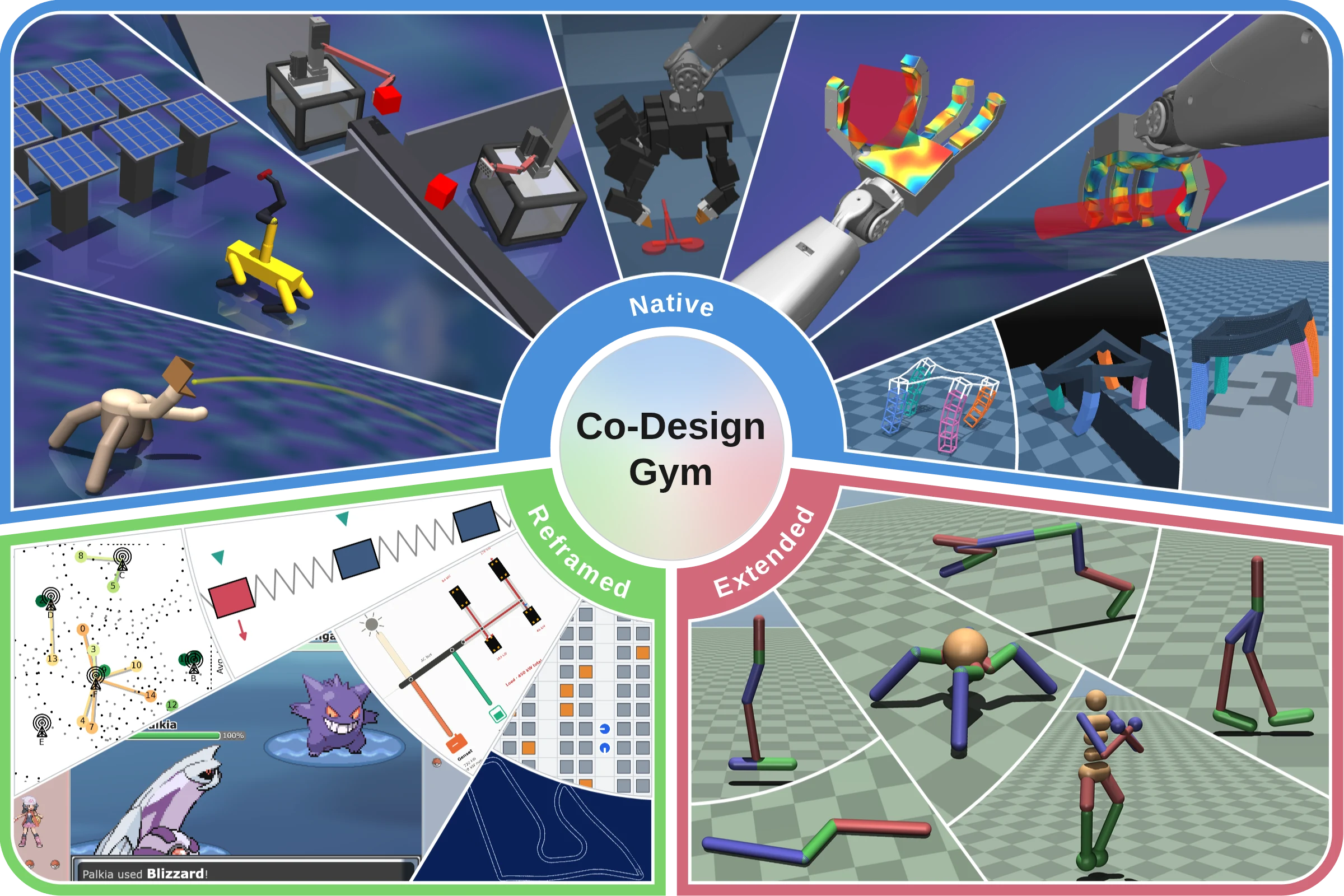
real rollouts from our baseline runs (the soft walker is an environment render)
The body shapes the brain.
The brain defines the body.
An embodiment decides what a policy can do; the best embodiment is the one whose policy does best. Optimize them apart and you leave performance on the table.
- Fix the body, and policy learning searches one slice of the landscape.
- Change the body, and the best policy changes with it.
- Co-design searches the whole landscape: a doubly non-stationary problem.
Try it yourself
Two tiny co-design problems, running live in your browser.
A 2D toy of our Ball Catcher: a longer arm reaches further but swings slower, so the right aim depends on the body you built.
Real 2D physics (planck.js). Every policy is tuned by a small genetic algorithm in your browser. Long legs walk about twice as far as the base body, but only with a policy tuned for them.
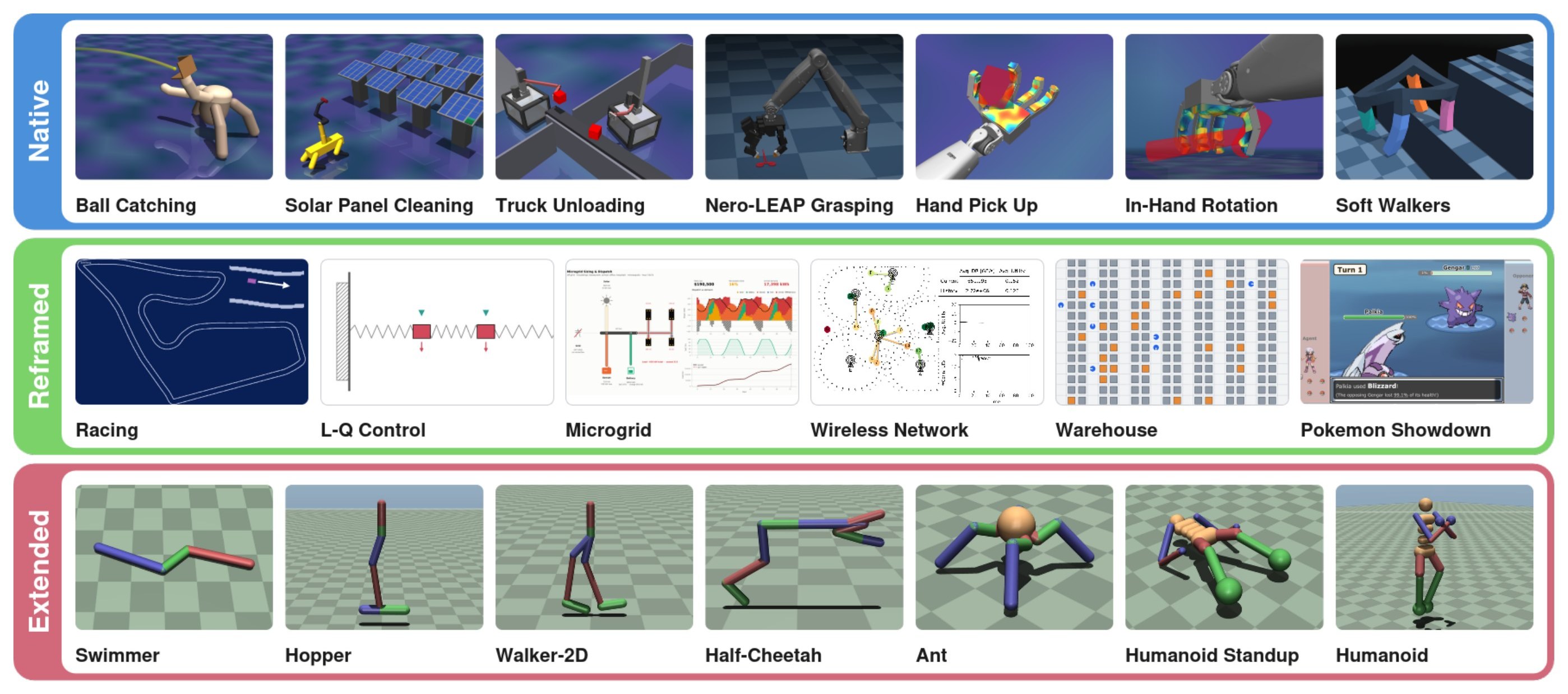
20 families. 86 presets.
Hover a card to watch it; tap for presets and code.
No single winner.
Lots of headroom.
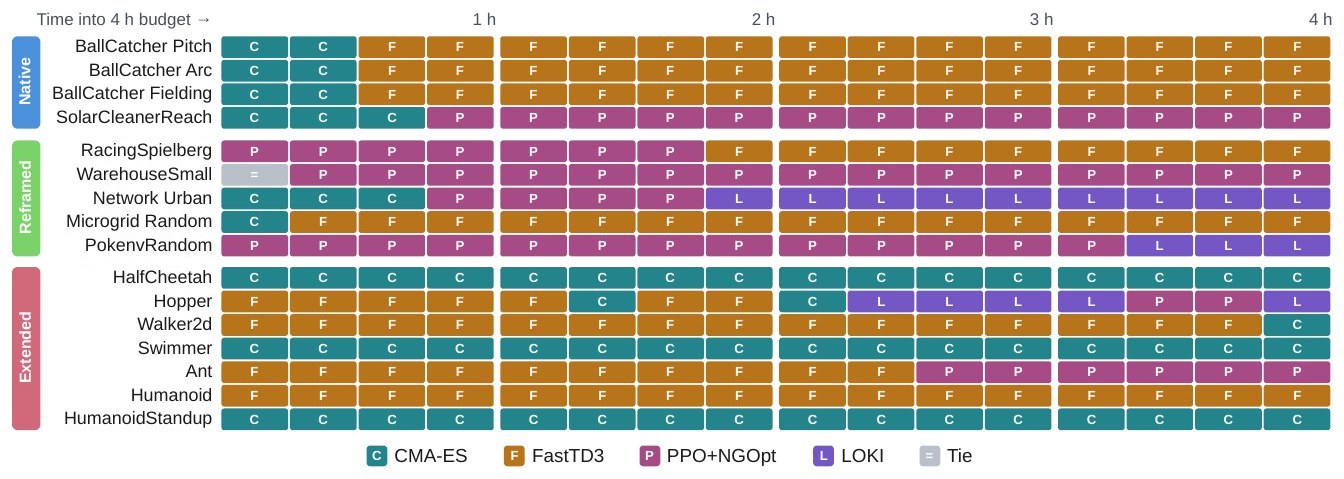
Four representative co-design methods (CMA-ES, FastTD3, PPO+NGOpt, LOKI), a matched 4-hour budget and 5 seeds each. None of them solves co-design. There is a lot of room for innovation.
No single winner
12 of 16presets where the leading method changes during training.
Who finishes ahead, out of 16 presets. Every method wins somewhere; none wins everywhere.
- 9 → 4 CMA-ES leads early on 9 presets, but finishes ahead on only 4.
- 0 methods lead on every domain group.
Lots of headroom
42%is the most any method reaches of the maximum return on our native & warehouse tasks.
Best method's final return as a share of the maximum, per preset. The dashed line is a solved task.
your method here?
Beat the scoreboard.
Every preset, every baseline, one make_vec call away, as soon as the code is released.
Dig into any preset
–
Lines: seed-mean eval return, step-held between evaluations; bands: ±1 std over seeds. An evaluation where every design was rejected is a gap.
Any optimizer. Any environment.
Any Gymnasium environment becomes a co-design environment by declaring an embodiment_space.
import codesign_gym as cg

# one entry point; returns the env and its base design
env, theta0 = cg.make_vec("BallCatcher-Pitch", num_envs=8)

# your outer loop proposes a design ...
theta = optimizer.ask(env.embodiment_space, theta0)
obs, rejected, info = env.reset(embodiment=theta)

# ... and your inner loop acts in it
for t in range(horizon):
    obs, reward, term, trunc, info = env.step(policy(obs, theta))
# reset returns a per-env rejection flag instead of raising
obs, rejected, info = env.reset(embodiment=thetas)
if rejected.any():
    # structurally impossible designs: out of bounds,
    # wrong shape, overlapping cells. Score them and re-propose;
    # stepping a rejected env is an error.
    optimizer.tell(thetas[rejected], penalty)

# check a design without touching the simulator state
ok = env.validate_embodiment(theta)
# Racing and the Shape-shifting Hand accept a design at every step
env, theta = cg.make_vec("RotateInHand", num_envs=64)
obs, _, _ = env.reset(embodiment=theta)
for t in range(horizon):
    theta = theta + 0.01 * design_policy(obs)   # reshape the pads
    obs, r, term, trunc, info = env.step(action, embodiment=theta)

# an eval env ignores step-time designs (with a warning),
# so a fixed design cannot be reshaped mid-episode
eval_env, _ = cg.make_vec("RotateInHand", 8, is_eval_env=True)
# envs/my_env/registration.py
def build_vec(num_envs, *, is_eval_env, **cfg):
    env = MyNativeVectorEnv(num_envs, **cfg)  # vmap, shards, warp...
    env.base_embodiment = default_design()
    return env

# codesign_gym/registry.py: one row, imported only when used
REGISTRY["MyEnv-v0"] = ("envs.my_env.registration:build_vec", {})
- One call.
make_vecreturns a GPU-parallel env and its base embodiment. - Design in
reset. Passembodiment=Noneand it is plain Gymnasium. - Honest evaluation.
is_eval_env=Truelocks the design for the whole episode.
Cite
If Co-Design Gym helps your work, please cite the paper. Read the paper on arXiv.
@misc{newatia2026codesigngym,
  title  = {Co-Design Gym: A Unified Benchmark for Embodiment-Policy Co-Optimization},
  author = {Newatia, Aviraj and Tsvetkov, Yordan and Pleiss, Leonard and Spielberg, Andrew and Antonova, Rika},
  year   = {2026},
  eprint = {2610.02366},
  archivePrefix = {arXiv},
  url    = {https://arxiv.org/abs/2610.02366}
}